June 2026
Attaining real sustainability; Fewer pets, but a bigger share of cats; Cats *are* important
Attaining Real Sustainability
This article is well worth reading to help us all make real progress toward a sustainable future for our pets and ourselves! Thanks to my dear friend (and fabulous animal communicator) Kate Solisti for sending it along.


Fewer Pets, but a Bigger Share of Cats
Pet adoption is slowing due to rising costs, especially in veterinary care, according to Bank of America. Younger and lower income households have experienced the biggest declines. People are buying fewer toys and accessories, and cheaper food as well.
The increase in veterinary prices is largely due to the gobbling up of local clinics by private equity and giant corporations that are highly profit-driven. But they may be shooting themselves in the foot because more people can’t even afford wellness visits, let alone expensive procedures. Pet insurance may help, but the underlying problem of veterinary medicine’s attempt to provide premium, human-level care remains. Not every abscess needs anesthesia, debridement, a drain, and top-tier antibiotics. Sometimes old-fashioned, common sense veterinary care is all that’s needed, with less stress, fewer side effects, and more ease on the wallet. Holistic care can also be a very cost-efficient option. (If you’d like access to a community where your questions can be answered personally by our experienced holistic veterinarians, visit Holistic Actions! For Healthy Pets.)
At the same time, cats are gaining in popularity. Their smaller size, compatibility with small-space living, and generally lower costs are appealing. Millennials, Gen Z, and men are driving this trend.
This is good news for cats, but needs to be tempered with reality. Cats really are second-class citizens when it comes to veterinary care. Only a third of cats get an annual exam, compared to 70% of dogs. It's not surprising that cats have historically received less attention in a veterinary world where dogs consume far more food, medications, and services. I have to say, in my personal experience, the majority of small animal vets are “dog people.” It’s not easy to find a veterinarian who is truly comfortable with cats and truly understands feline behavior, health, and emotional needs.
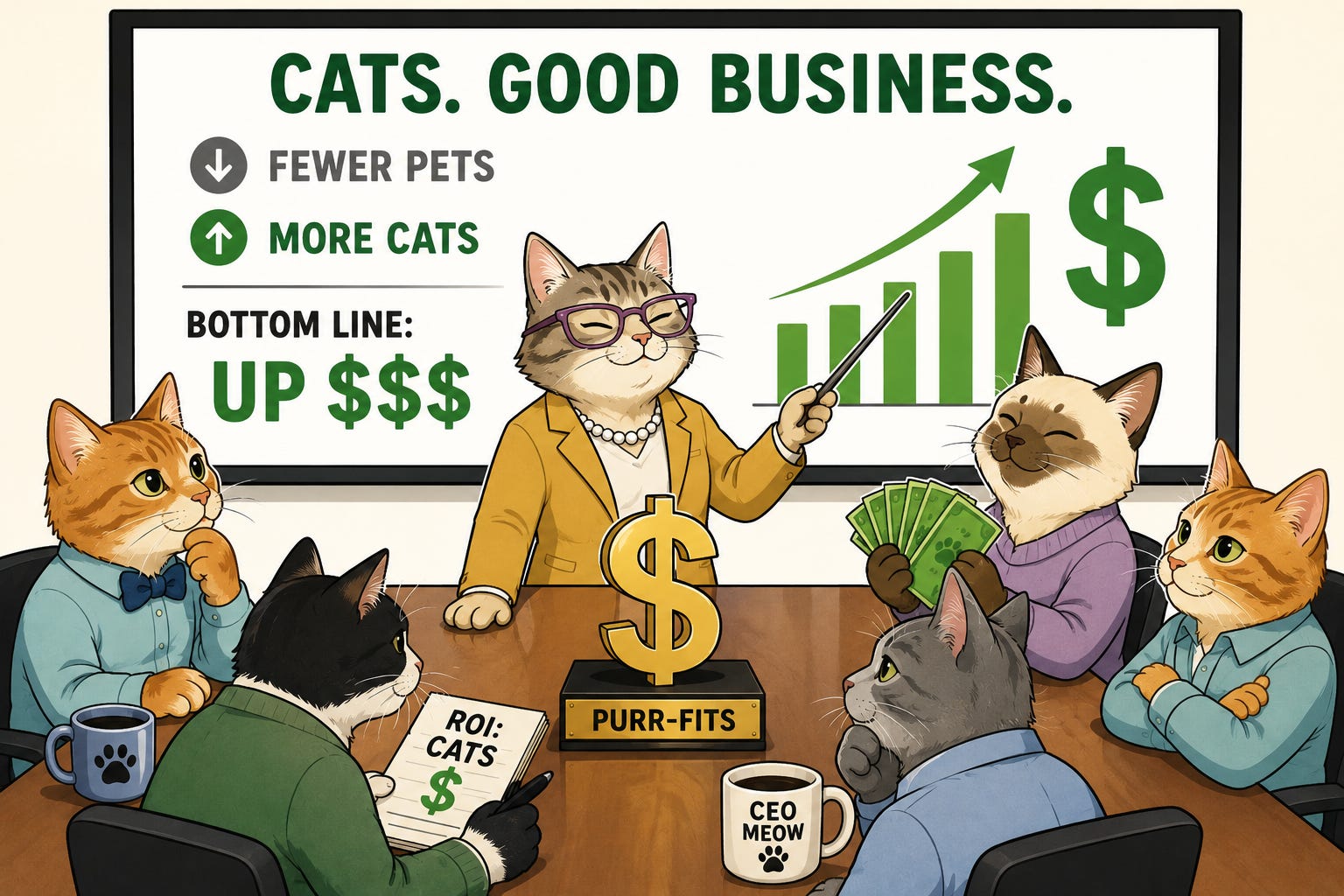
The articles I’ve linked above are interesting because they look at the issue from the business side. Pet business expos are calling this “the Year of the Cat.” To quote from the report, “we now know who these owners are, what they believe, what they misunderstand, and exactly what language would bring them in more often.” I think it’s important for cat guardians to understand the economics, so that when veterinarians suddenly realize their failure to pay sufficient attention to cats and make a bid for your hard-earned dollars, you understand what’s really happening.
But it’s just as important for cat lovers to understand that our kitties need the same level of care as any pet: an annual veterinary exam (or more often, for seniors), preventive dental care, social interaction, and an engaging environment. I know my readers are on it, but please help spread the word that cats are awesome but they still take time and effort, they still cost money, and they are still way smarter and better than dogs. (Just kidding. Sort of.)
Cats are important!
In vet school, they were always telling us students: “Cats Are Not Small Dogs.” Nevertheless, the veterinary profession, and frankly the entire pet industry, still treats them as such. And thirty years later, they’re still just beginning to figure this out.
For decades, cats have been overlooked in research. A fascinating new study suggests that may finally be changing.
Scientists recently analyzed nearly 500 feline tumors from a variety of cancer types. This is one of the largest studies of feline cancer genetics ever conducted. It’s the foundation of a huge and important database. But it’s what they found that’s worth noticing. Many feline cancers share important genetic mutations with human cancers, including mutations known to drive tumor growth.
Biomedical research is still conducted largely in mice and rats. Unfortunately, what we learn from rodents does not always transfer well to either veterinary or human medicine.
Dogs have also been popular research subjects because they share many similarities with humans. Studies in canine cardiology and orthopedics, for example, have contributed to significant advances in human medicine.
Cats, meanwhile, have often been overlooked. Dogs receive more research funding, more studies, and more attention. Cats can be more challenging to work with, and historically there has been less financial incentive to develop feline-specific products and treatments.
But this research suggests that some feline cancers share remarkable similarities with certain human cancers. Studying these similarities may eventually benefit both feline and human patients.