
August 2025
Declawing Causes Long-term Pain; Darwin's AGAIN; Bird Flu Wrap-Up
Hi all! I’ll be traveling for several weeks, mostly camping, so getting the newsletter out is a bit tricky. I’m at the laundromat today (with both electricity and WiFi!) so I’m taking the opportunity to send this out!
Declawing Causes Long-Term Pain
A newly published study in the well-respected journal Nature confirms what anyone with a drop of compassion or common sense has known all along: declawing is bad for cats! It causes long-term neurologic dysfunction and lifelong pain.
It’s long been known that old cats get osteoarthritis (OA, but commonly known as plain old arthritis). Kitties’ jumping and playing habits of a lifetime take their toll! More than 90% of cats over 12 have arthritis bad enough to be visible on x-rays. Increased body weight makes the effects of arthritis worse, and much more so in declawed cats. Given that more than 60% of cats are overweight, and up to 25% of them are declawed, that is an awful lot of cats in an awful lot of pain.
This study tried to determine how declawing may affect OA. They found that there were greater functional and biomechanical impairments among declawed cats. There were also significant neurologic changes. The authors provide compelling evidence that declawing leads to chronic pain and physical impairment far more beyond that experienced by arthritic but non-declawed cats. Declawed cats suffer chronic nerve injury, impaired mobility, and heightened pain sensitivity,
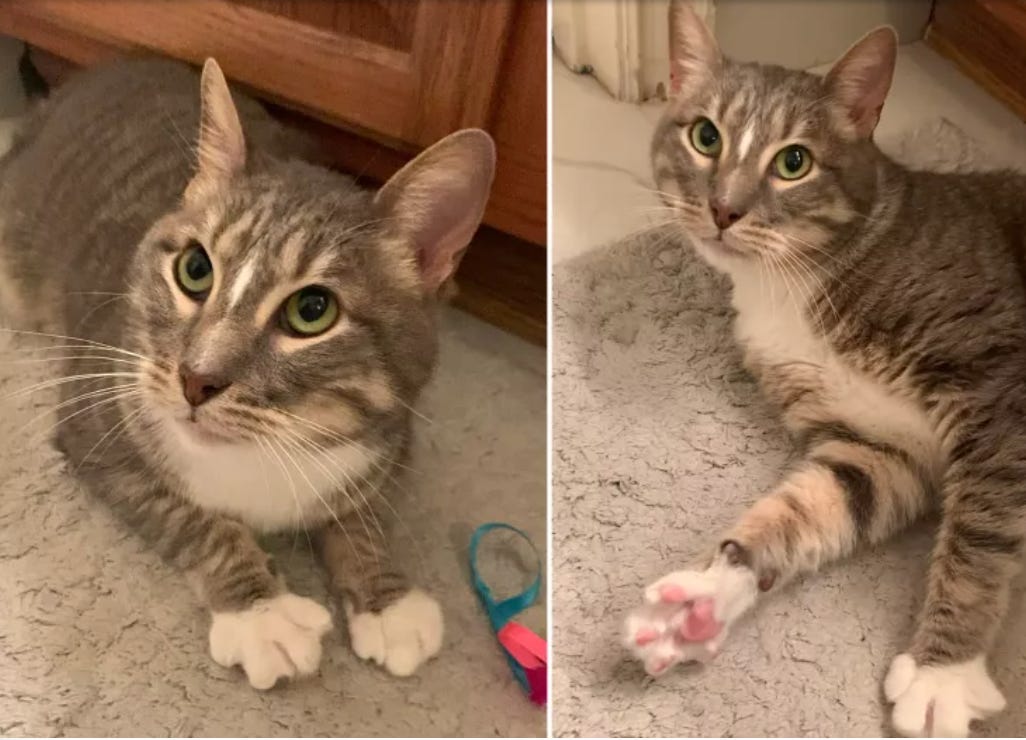
The study authors call for a worldwide ban on declawing as an ethically unacceptable intervention with lasting negative consequences for cats.
Read the full study in Nature here: tinyurl.com/declawing2025
BTW, before anyone comments that *THEIR* cat shows no signs of pain, understand that cats are extremely stoic and hide their pain until it is completely unmanageable. If a cat is limping on both front feet, or all four paws, you won’t see it. Declawed cats are painful, and if anyone is monster enough to want to mutilate a cat this way—well I say, “You do not deserve a cat.”
Darwin’s AGAIN
I wish I didn’t have to keep posting updates about Darwin’s unethical antics. This time, a child became seriously ill from their bacteria-laden food, but they are still in major denial and refuse to issue a recall of the food. This time, they managed to incorporate both pathogenic E. coli: O157:H7 and Salmonella. FDA states: “These products, which were manufactured in May or June 2024, were sold frozen, have no expiration date on the label, and could still be in consumers’ freezers.” This time, all the lots were of dog food, but Darwin’s appears to be an equal-opportunity contaminator and has had its cat food affected before. You will not find any information about this on Darwin’s website.
Darwin’s Natural Pet Products, BioLogics All-Natural and Grain Free, Beef Recipe for Dogs
Lot 10662, MFG Date: May 30, 2024
Darwin’s Natural Pet Products, BioLogics All-Natural and Grain Free, Chicken Recipe for Dogs
Lot 10683, MFG date: June 05, 2024
Darwin’s Natural Pet Products, Natural Selections Duck Recipe for Dogs
Lot 10638, MFG date: May 22, 2024
Bird Flu Wrap-Up
As promised, here is what I hope will be the last thing I have to write about bird flu! It’s a summary of what has gone before, with my personal recommendations at the end.
Overview
Highly Pathogenic Avian Influenza (HPAI), commonly known as bird flu or H5N1, has emerged as a major concern in 2025. Although human cases remain rare—just 70 confirmed, all linked to direct contact with infected animals—the virus has proven especially lethal to cats. Hundreds of domestic and wild felines have died, and outbreaks continue across the U.S., from Oregon to Texas to New Jersey.
Government Response
In July 2025, the CDC officially ended its emergency response to H5N1 and scaled back monitoring efforts from weekly to monthly. However, the USDA continues to track animal cases, and the virus remains active in dairy herds, poultry, wildlife, and domestic cats. Unfortunately, USDA only reports species and dates, without any information on how the animal became infected. The government’s lackadaisical approach makes it harder to understand how and where the virus is spreading.
Transmission Pathways H5N1 spreads through:
Bodily fluids (saliva, nasal discharge, feces, milk)
Airborne particles (dust or droplets)
Contaminated surfaces and equipment (fomites)
Direct contact between animals
Ingestion of infected meat or milk
Cats are particularly vulnerable due to their carnivorous diet and hunting behavior. Raw meat and unpasteurized milk are significant sources of infection. It appears that even asymptomatic animals can transmit the virus.
Wildlife Impact
The ecological toll is truly staggering. At least 406 bird species and 51 mammal species have been infected globally. Bald eagles have been affected in 24 states, and only 4% of elephant seal pups in Argentina survived this year. Species like penguins, skuas, pelicans, and even endangered California condors have suffered dramatic losses. Alarmingly, 25% of affected mammals and 16% of bird species are already considered near-threatened or worse.
Symptoms in Cats
Bird flu in cats can mimic many other illnesses, making diagnosis difficult. Common signs include:
Lethargy or depression
Poor appetite
Fever
Red eyes
Eye and/or nasal discharge
Sneezing
Coughing
Difficulty breathing
Neurological symptoms (tremors, seizures, unsteady gait, blindness)
Symptoms often begin with respiratory issues but can escalate rapidly. Death may occur within 24 hours of showing neurologic signs. However, some cats may show only mild signs—or none at all—making subclinical (silent) transmission a real concern.

Testing and Diagnosis
Most diagnoses occur postmortem, but live testing is available. Veterinarians can collect blood, urine, or swabs from the eyes, nose, or throat. Each test costs around $50, and the USDA may cover the cost if contact information is provided. Because bird flu is a reportable disease, positive results trigger mandatory reporting to state and federal agencies.
Raw Food Risks
So far, no retail grocery poultry has tested positive for bird flu. It is all USDA inspected (for what that’s worth, and we can certainly quibble about that!). Positive-testing flocks are culled, and the meat should never enter the human food supply. Even nearby flocks are quarantined and monitored.
Outbreaks at poultry facilities are still occurring as of July 2025.
However, bear in mind that retail poultry is a source of many pathogens, including Salmonella, Listeria, and Campylobacter bacteria. It is intended to always be cooked.
In eggs, the virus may survive in the yolk, though the risk is very low. In an adult human, consuming enough virus from eggs to get sick is unlikely, but in a ten pound cat… well, personally, I’d cook the eggs.
Dehydrating, freezing, or freeze-drying does not inactivate or kill any viruses. (It doesn’t kill bacteria or fungi either!) If HPP is not used during production, it is most likely safe, but caution is still warranted.
Raw Milk: Just Don’t
Raw milk is particularly dangerous because infected cows produce huge numbers of virus particles that concentrate in the udder. Bird flu has been found in more than 1000 dairies in the U.S. (most in California, where raw milk is legal), but only 10% of cows have become ill, and the cull rate is less than 2%.
Here are my current recommendations:
· Keep cats indoors; walked on a harness or leash so you can control what they sniff or eat; or in a secure outdoor enclosure with mesh small enough to exclude birds and rodents. That’s a very big deal. Most existing enclosures will need to have fine mesh screens added to keep mice, shrews, and voles out. Transmission from wild animals is my biggest concern.
· Grocery-store meat, poultry and eggs are probably safe to feed raw. Yes, it’s possible that a sick chicken or turkey could get through the slaughter process. But the time from infection to death in poultry is less than 24 hours, so the chances are small. Producers are more vigilant, and new rules for testing and quarantines have been put in place
· Pasture-raised chickens and eggs and backyard flocks have more exposure to wild birds and rodents than warehoused commercial flocks. However, they are thought to be less stressed and have better immune systems. While many backyard flocks have had to be culled, no pastured commercial flocks have tested positive.
· Commercial raw pet diets using HPP are most likely safe. The FDA has ordered raw pet food makers to account for bird flu in their safety plans. But there are no time limits or specifications for that rule. I expect that manufacturers using HPP have adjusted their settings to those known to inactivate avian flu (there is already existing research on this).
If you are feeding raw meat, especially poultry:
· I am personally wary of feeding any raw, dehydrated or freeze-dried food that has not undergone HPP unless you cook it at least partially. The recommended temperature is 165 oF (which kills everything, including flavor!). But further research has shown that140 oF (about medium doneness) is enough to inactivate this virus.
· To make up for losing the “live” factor in raw food, add digestive enzymes, prebiotics, and probiotics. This product contains all three, but there are many good choices.
· Also add a little extra moisture (water or broth) to maintain hydration.
· If you are feeding a “complete” raw food, add a little bit of B vitamin complex (including choline) after warming, since the Bs are very sensitive to heat. [My friend and colleague, veterinary nutritionist Dr. Susan Wynn, pointed out that many raw diets are formulated with narrow margins for required nutrients. However, the AAFCO profiles include a safety buffer, so other than the B vitamins, warming the food should not harm its nutritional value.]
Conclusion
While it’s not—and may never be—time to hit the panic button, do keep an eye on your pets, and ask your veterinarian about any suspicious symptoms that arise, especially with potential or known exposure to bird flu.